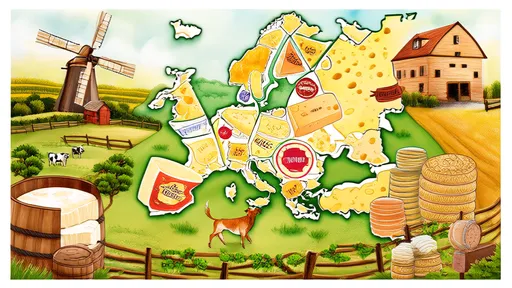
Europe’s countryside is dotted with family-run farms where cheese-making traditions have been passed down through generations. These hidden gems offer more than just a taste of local flavors—they provide a window into the cultural heritage of each region. From the grassy hills of Normandy to the rugged mountains of Switzerland, every bite tells a story of craftsmanship, terroir, and time-honored techniques. For travelers seeking an authentic gastronomic adventure, following the cheese map of Europe is a journey worth savoring.
Normandy’s Creamy Treasures
In the rolling pastures of Normandy, the air carries the scent of salt from the nearby sea mingling with the rich aroma of cow’s milk. This region is the birthplace of Camembert, a cheese so iconic that it has become synonymous with French culinary pride. Visiting a small-scale producer here means witnessing the careful hand-ladling of curds into molds—a method unchanged for centuries. The result is a velvety, earthy cheese with a rind that yields to the slightest pressure. Pair it with a crisp local cider, and you’ll understand why Normandy’s dairy farmers guard their recipes so fiercely.
The Alpine Mastery of Switzerland
High in the Swiss Alps, where cows graze on wildflowers and herbs, cheese-making is less an industry and more a way of life. Gruyère and Emmental are the stars here, their distinct flavors shaped by the altitude and the meticulous aging process. In mountain chalets, copper vats simmer with milk, and cheesemakers rely on intuition honed over decades to judge the perfect moment to cut the curd. The aging cellars, carved into the mountainside, maintain a constant humidity that allows these wheels to develop their signature nutty sweetness. A visit often ends with a rustic fondue, where melted cheese becomes a communal celebration of Alpine tradition.
Italy’s Underground Secrets
Beneath the sun-drenched hills of Parma and Piedmont lie caves where cheeses like Parmigiano-Reggiano and Gorgonzola mature in silent darkness. The process is unhurried—some wheels age for years, tended by affineurs who rotate and test them with small hammers, listening for the right sound. In these regions, cheese is treated with reverence, often protected by strict designations that dictate everything from the breed of cow to the feed they consume. A farm visit might include a tasting of stracciatella—a creamy, torn-curd delicacy—paired with a drizzle of aged balsamic, a combination that captures Italy’s genius for simplicity.
The Bold Flavors of the Netherlands
Dutch cheese markets, with their colorful wheels stacked like edible architecture, are a feast for the eyes as much as the palate. But behind the bustling trade lies a network of small farms where Gouda and Edam are still made using raw milk and wooden presses. The coastal breezes infuse the milk with a briny note, while the lush grasslands contribute to the cheese’s buttery texture. Many farms welcome visitors to watch the curds being pressed into their iconic spherical molds, followed by a tasting of young and aged varieties that showcase the Netherlands’ mastery of controlled fermentation.
Spain’s Smoky and Sheep’s Milk Wonders
In the rugged landscapes of La Mancha and the Basque Country, cheese takes on bold, unexpected forms. Here, Manchego—made from the milk of hardy local sheep—develops a caramel sweetness under its zigzag-patterned rind. Meanwhile, Idiazábal, often smoked over beechwood, carries whispers of campfires and ancient pastoral traditions. Farm visits might include a demonstration of how the curds are set using thistle rennet, a technique dating back to Roman times, followed by a sip of robust Rioja to cut through the richness.
The Unexpected Cheese Cultures of Eastern Europe
Beyond the well-trodden paths of Western Europe, countries like Poland and Romania harbor their own cheese legacies. Oscypek, a smoked sheep’s milk cheese from the Polish highlands, is shaped into intricate spindle forms using hand-carved molds. In Transylvanian villages, caș—a fresh, crumbly cheese—is often served with honey and walnuts, a testament to the region’s pastoral simplicity. These lesser-known varieties remind us that Europe’s cheese map has endless corners to explore, each with its own narrative of survival and adaptation.
From the pungent blues of England’s Stilton to the delicate brininess of Greek feta, Europe’s farms offer a living encyclopedia of cheese. What makes these visits unforgettable isn’t just the flavors, but the people behind them—the third-generation cheesemaker who knows each cow by name, the affineur who can tell a cheese’s readiness by its aroma. To travel this map is to discover that cheese, in its purest form, is a language of place, patience, and passion.

By /Jul 8, 2025
By /Jul 8, 2025

By /Jul 8, 2025

By /Jul 8, 2025

By /Jul 8, 2025

By /Jul 8, 2025
By /Jul 8, 2025
By /Jul 8, 2025
By /Jul 8, 2025
By /Jul 8, 2025

By /Jul 8, 2025

By /Jul 8, 2025

By /Jul 8, 2025

By /Jul 8, 2025

By /Jul 8, 2025
By /Jul 8, 2025

By /Jul 8, 2025

By /Jul 8, 2025

By /Jul 8, 2025

By /Jul 8, 2025
